

Exchange-traded fund flows have been more supportive than the original figures suggested. Over the four US trading sessions from 20 to 23 July, spot Bitcoin ETFs recorded a combined net inflow of approximately USD 274.0 million, while spot Ethereum ETFs attracted around USD 174.5 million. In other words, both figures represent inflows rather than outflows, although Bitcoin funds ended the period with a sharp USD 225.1 million daily outflow on 23 July.
Cryptocurrency prices remain sensitive to uncertainty surrounding US monetary policy and geopolitical risks. June inflation data showed a clear slowdown: annual consumer inflation fell from 4.2% to 3.5%, while the core CPI rate declined from 2.9% to 2.6%. Producer prices also eased, with headline PPI slowing to 5.5% year-on-year. The broader measure excluding food, energy and trade services rose by 5.1%, meaning that underlying producer inflation remained elevated despite the improvement in the headline reading.
The weaker CPI figures reduced the likelihood of an immediate Federal Reserve rate increase, and economists widely expect the central bank to leave borrowing costs unchanged at its July meeting. The outlook beyond July is less certain. A Reuters poll found that the median forecast still pointed to unchanged rates through the end of 2026, although a majority of economists described the probability of at least one increase this year as high. Interest-rate futures had also assigned a substantially higher probability to a move by September than to an increase in July.
Energy and trade risks remain important sources of inflationary pressure. Shipping through the Strait of Hormuz has already been severely disrupted, while the Bab el-Mandeb Strait remains at risk but has not been confirmed as fully closed. A simultaneous disruption of both routes would intensify pressure on global energy supplies. At the same time, the Trump administration has introduced new tariffs of 10.0% and 12.5% on imports from 60 trading partners over alleged failures to enforce bans on goods produced with forced labour. The measures cover approximately 99.4% of US imports, although oil, gas, fertiliser and several other categories are exempt.
Market participants are also monitoring the progress of the CLARITY Act, the proposed US cryptocurrency market structure legislation. Senate Republicans unveiled the latest text on 22 July, but the bill still requires bipartisan support to advance. One of the most disputed areas concerns ethics rules for senior political figures and the authority responsible for enforcing them. The current text assigns enforcement to the US Department of Justice and prevents state attorneys general from bringing cases, an approach that has drawn objections from some Democrats. With the August congressional recess approaching, the available window for reaching a compromise remains narrow.
Weakness in major US technology stocks has added another layer of volatility. Investors have become increasingly concerned that spending on artificial intelligence infrastructure is rising faster than the resulting cash flows. Alphabet’s first recorded quarterly cash burn and its higher capital expenditure forecast intensified scrutiny across the sector. However, there is not yet sufficient evidence to state that investors are directly moving capital from AI stocks into cryptocurrencies; for now, this remains a possible market-rotation scenario rather than a confirmed trend.
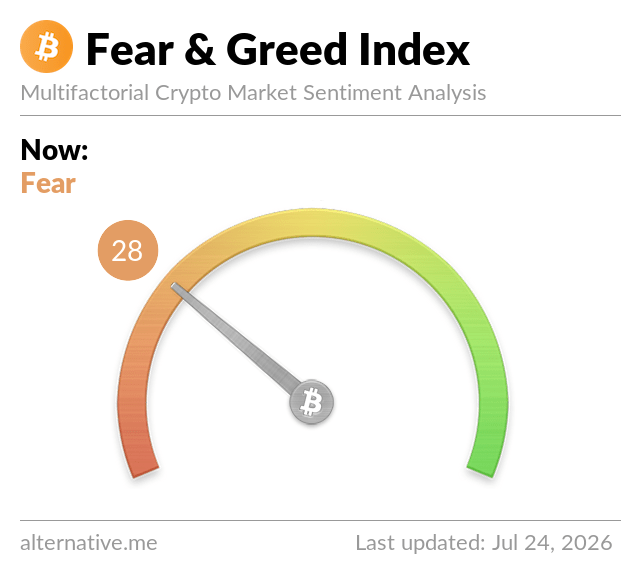
Overall sentiment remains fragile. The Crypto Fear and Greed Index published by Alternative.me stands at 28, keeping the market in the “Fear” zone. This does not guarantee another decline, but it indicates that investors remain cautious and that leading cryptocurrencies may continue to experience elevated volatility, consolidation or renewed selling pressure in the near term.
While leading cryptocurrencies remain under pressure and continue to trade well below their previous highs, market participants can use this period to make a more considered choice of trading platform. FORECK.INFO provides an up-to-date cryptocurrency exchange ranking, where platforms can be compared by fees, reliability, available tools and trading conditions.